.png?width=80&height=80&name=Untitled%20design%20(1).png)
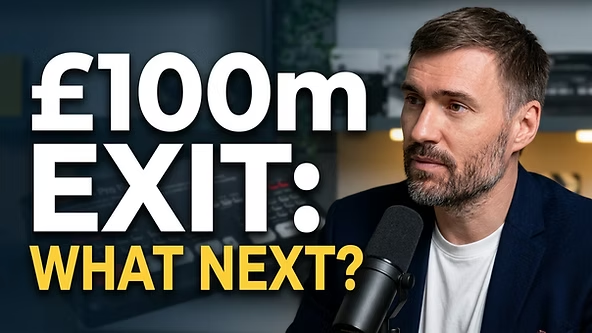
Growing up on a council estate in Oxford, nearly losing his life at 15, watching his dad spend 46 years on a factory floor, Andrew built one of the UK's most respected FM businesses from scratch, with nothing but belief, hard work, and a phone call to a hotel contact on day one. By the time he exited Pareto FM, he'd grown it to £50M turnover, 550 staff, and two private equity exits.
But, the biggest takeaway from this podcast? The money isn't the most interesting part of his story.
The Start Nobody Talks About
Before the awards. Before the exits. Before the McLaren he eventually sold because he felt like "too much of a knob" driving it — there was a 15-year-old kid on a council estate who nearly killed someone and nearly got killed himself.
Andrew doesn't dress it up. By 16 he was heading in a direction that could have ended everything. What changed it wasn't some inspirational teacher or a life-changing book. It was circumstance. He ended up in a sixth form surrounded by kids who had aspirations, two parents, and a plan. And somewhere in that environment, something shifted.
It's a reminder that context shapes everything. The ambition was always there. It just needed somewhere to go.
Building Pareto FM With Nothing
When Andrew handed in his notice at 27 and told his wife he was starting his own business, she said no. They had a mortgage. A family on the way. Less than £10k in savings.
He did it anyway.
Day one. Just him and a laptop. He picked up the phone to a hotel contact from his previous role, converted the contract within months, and used the momentum from that first win to land Yahoo, Candy Crush, and London Zoo within the first year. By the end of year two, Pareto was running at £5M turnover.
No funding. No backers. No investor deck. Just an inherent belief that large organisations weren't serving smaller clients well, and that he could do it better.
What's striking about how Andrew talks about those early years is the absence of glamour. He was doing invoices on Sunday nights. Working 100-hour weeks on a salary that wouldn't turn many heads. Taking calls on Christmas Day because the reindeer had escaped at London Zoo. There was nothing romantic about it and he's the first to say so.
The People Thing
One of the most valuable parts of this conversation isn't about growth strategy or private equity. It's about people.
Andrew talks about how his nan used to host 30 family members every Sunday in a house that wasn't big enough for half of them. Cheap food. Compulsory attendance. Community as a non-negotiable. That upbringing, he says, gave him something no business school could, the ability to connect with people on their level, without pretence.
He never took the nice car to client meetings. He never tried to be the smartest person in the room. He just showed up, did what he said he'd do, and created an environment where people wanted to stay. His top team of 15. every single one of them stayed for the entire 10-year journey.
That's not luck. That's culture.
The Cost of Building Something
Here's where Andrew gets honest in a way that a lot of founders don't.
For the best part of a decade, he wasn't present. Not really. His wife would ask for a Sunday afternoon. His phone was always in his hand. His daughter, when she was barely old enough to talk, picked his phone up and handed it back to him, because that's what she thought he was supposed to be holding.
That moment, he says, was the one that stuck.
He's not telling this story to be self-flagellating. He's telling it because it's real, and because he thinks too many founders are heading in the same direction without realising what's waiting for them on the other side of the exit.
His advice is simple. Put the phone away. Be deliberate about the time you spend with the people that matter. Write things down at the end of the day. And when you eventually get to the island, know what you're going to do when you get there, or the silence will be deafening.
What the Office Actually Is
Andrew spent a decade running FM contracts for some of the most recognisable brands in the world. Twitter. Candy Crush. Bulgari. London Zoo. And what he learned across all of them is something that sounds obvious when you say it out loud, but most organisations still haven't figured out.
The office isn't a place to work. It's a place to be human.
The water cooler conversations. The incidental meetings. The knowledge that gets shared between two people walking to the tube after a networking event. That's where the real stuff happens. And if you're designing a workplace, or a working policy, without thinking about how to create those moments, you're missing the point entirely.
For younger people especially, his message is clear. Be in the office. Learn from the people around you. Presenteeism isn't a dirty word, it's how Andrew went from a junior commercial role to director of 250 people by the age of 24.
The One Sentence That Sums It Up
When I asked Andrew to nail it in a sentence, "what actually made him successful" — he went back to something his business studies teacher said when he was 14.
Don't let the bastards grind you down.
Stop comparing yourself to other people. Cancel out the noise. Be your own biggest critic. Work out what success looks like for you, not for anyone else, and then go after that.
Simple advice. Genuinely difficult to live by.
This is one of the best conversations I've had on the Future Workplace Podcast. Andrew is open, funny, and completely unfiltered and there are lessons in here for anyone building something, managing people, or trying to figure out what balance actually looks like.
Listen to the full episode here — link below. And if you found this useful, share it with someone who needs to hear it.